

Integrity Diagnostics
Review documents and data for gaps, weaknesses and potential signs of fraud.
At any stage · Investigations and response
A report, audit finding or serious allegation can demand immediate action. We help investors, boards and leadership teams assess what has been raised, choose the right route and keep the response focused on the decisions that may follow.
The need
An allegation may be serious, incomplete or both. Acting too quickly can expose people, compromise evidence or send the work towards the wrong specialist. Waiting can be just as damaging. The first task is to establish what is required, what the response needs to achieve and which route is appropriate.
Our method
What we provide
We triage and direct the investigation, bringing in the right specialists for the context and objectives. That may include lawyers, forensic accountants, digital specialists, interviewers or local expertise. We keep the work tied to the questions that need answering and the decisions the client may need to make.
Investigation direction

Investigation support
Document and data review
Review documents and data for gaps, weaknesses and potential signs of fraud.
Ranulph supports professional judgement. It does not prove misconduct or replace an investigation.
Where we help
The work can begin when a concern first appears, when an existing investigation needs direction, or when findings require a clear response.
Assess the position and choose the right response.
Review its direction, scope and use of specialists.
Turn the findings and uncertainty into practical decisions.
Illustrative experience
50cases across 22 countries in nine months
Findings and action
FAQ
Gather all available information, separate facts, assumptions and unknowns, then conduct a preliminary assessment of credibility, verifiability and materiality before deciding whether the matter needs immediate action, more information or an investigation.
No. Do not send names, allegations or sensitive information through the public website. If a matter needs more detail, Ethics Insight can agree an appropriate way to share information after an initial conversation.
Ranulph brings context, documents, data and public-source material into one structured review. It helps teams assess exposure, review documents and data for gaps and weaknesses, generate follow-up questions, support gap analysis and action planning, and use tools such as Integrity Diagnostics and Harmoniser where relevant.
Explore
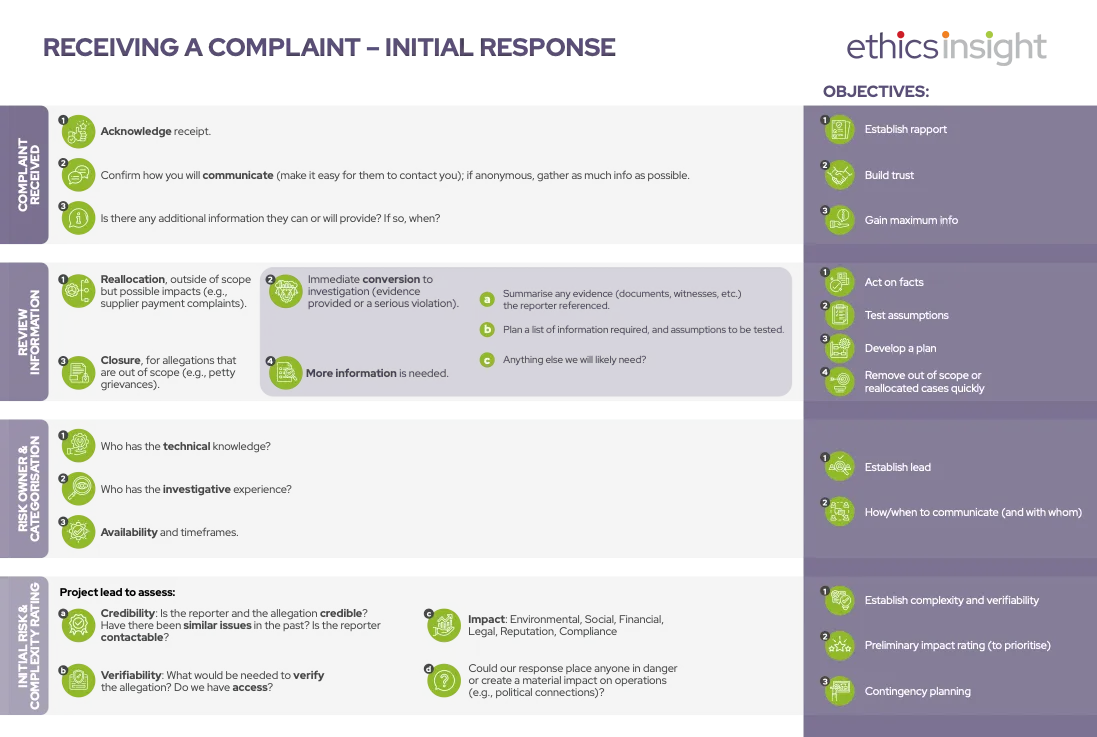
A practical guide to the first decisions after a concern is raised, including immediate safeguards and mistakes to avoid.
Receive the guide by email
You may have just received a concern, need an independent view of an investigation already underway, or be deciding what to do with the findings. Tell us a little about the situation without naming people or sharing evidence. We will ask a few questions and tell you whether we can help.
Please do not send names, allegations, sensitive evidence or files through the website.